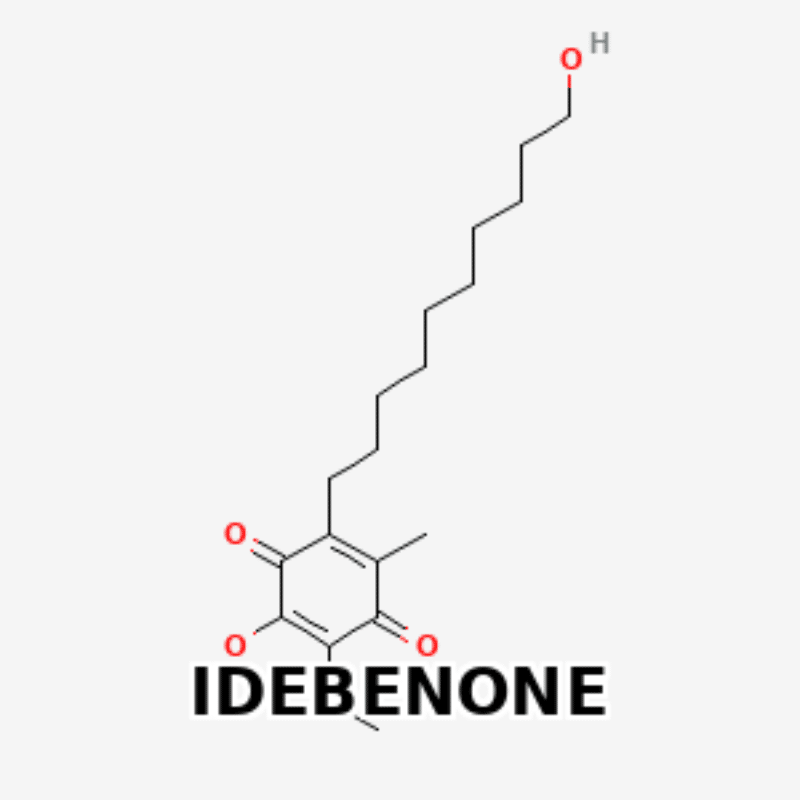
Idebenone is a synthetic short-chain benzoquinone structurally related to coenzyme Q10 analogues. It has been widely examined in scientific literature for its role in cellular energy processes, mitochondrial function research, and oxidative stress modulation pathways.
Due to its molecular properties, Idebenone has attracted research interest in areas involving electron transport activity, free radical regulation, and cellular bioenergetics models. Its stability and lipophilic characteristics make it a compound of interest in laboratory investigations focused on redox balance and mitochondrial dynamics.
This material is intended for controlled laboratory environments where purity, traceability, and handling standards are essential.
Areas of Research Interest
-
Investigated in studies related to mitochondrial electron transport mechanisms
-
Explored for potential involvement in cellular energy metabolism
-
Studied in oxidative stress and redox modulation models
-
Examined for stability characteristics compared to CoQ10 analogues
-
Evaluated in experimental systems involving neurobiological and metabolic pathways
Indirectly Associated Neurotransmitter Systems
Because neuronal signaling is highly energy-dependent and sensitive to oxidative stress, Idebenone has been explored in models involving:
-
Dopamine
Studied in neurodegenerative models where dopaminergic neurons are energy-vulnerable. -
Glutamate
Investigated in relation to excitotoxicity models and oxidative stress modulation. -
Acetylcholine
Examined in cognitive research contexts due to mitochondrial involvement in cholinergic neurons. -
Serotonin
Indirect modulation discussed in broader neuroprotective experimental settings.